Hotel Del Luna
In the heart of Seoul, a decrepit building stands. To passersby, it looks like a condemned structure on the verge of demolition. But to wandering spirits, something entirely different comes into view — a lobby bathed in golden light, elegant vintage rooms, and at the center of it all, a woman. Wide-brimmed hat, vintage dress, and eyes that hold 1,300 years of resentment. This is Jang Man-wol, owner of Hotel Del Luna.
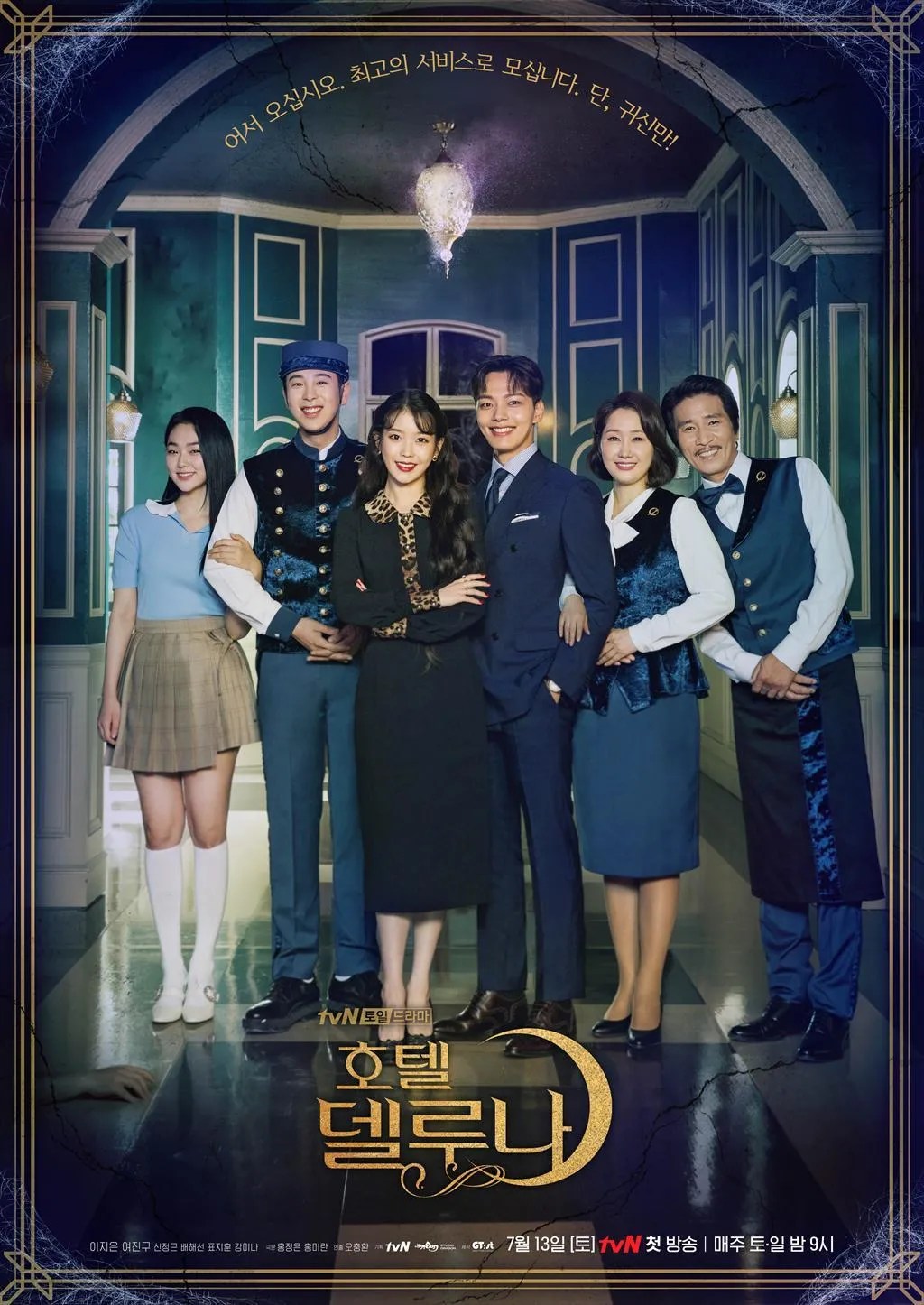
Hotel Del Luna | 2019 | 16 Episodes | Fantasy, Horror, Romantic Comedy
Available on Netflix, Disney+ (availability may vary by region)
In the summer of 2019, this drama debuted to a 7.3% premiere rating and climbed steadily to 12% for its finale, becoming one of the most talked-about shows of the year. But more impressive than the numbers is what the drama left behind: the character of Jang Man-wol, over 100 costume changes, an OST that dominated the music charts, and a pilgrimage trail stretching from the Mokpo Modern History Museum to Quebec City. Hotel Del Luna demonstrated the full range of cultural impact a single drama can generate.
The Phenomenon of Jang Man-wol
When news broke that IU would play Jang Man-wol, the reaction was a mix of curiosity and skepticism. Could a singer beloved as "the nation's little sister" inhabit a flamboyant, temperamental woman who had run a ghost hotel fueled by 1,300 years of grudges? The answer left no room for doubt. The actress who had channeled Lee Ji-an's raw pain in My Mister redirected that energy in a completely different direction here. Jang Man-wol is capricious, extravagant, and brutally honest. Yet beneath it all, 1,300 years of loneliness sit like shadows under her eyes. IU contained both dimensions in a single breath, and this role cemented her place among Korea's most trusted actors.
Jang Man-wol's fashion is a narrative unto itself. From late Joseon-era hanbok to 1920s Art Deco to contemporary high fashion — over 100 outfits appeared across the sixteen episodes, with each installment functioning like a runway show. This wasn't mere costume design. It was a way of expressing the inner world of a character who has lived for over a millennium through what she wears. Jang Man-wol's extravagant wardrobe isn't vanity — it's armor. A defense mechanism: wrapping the exterior in ever more brilliance to avoid revealing what's inside.
Two People, One Balance
Yeo Jin-goo's Gu Chan-sung is Jang Man-wol's polar opposite. Principled, diligent, rational — an elite hotelier. He has been able to see ghosts since childhood but has suppressed that ability, living a normal life. When fate installs him as the manager of Hotel Del Luna, he clashes daily with an owner who has spent a thousand years doing as she pleases — yet slowly, steadily, he reaches the truth of who she really is.
From playing the young king in The Moon Embracing the Sun to inhabiting a dual personality in The Crowned Clown, Yeo Jin-goo had long proven his range. In this drama, he demonstrates the art of generous acting. When IU's Jang Man-wol takes the explosive emotional beats, Gu Chan-sung quietly receives them. This dynamic sustains the entire drama. The emotional arc between them isn't push and pull — it's two people gradually adjusting to each other's temperature.
A Hotel for the Dead, Stories for the Living
Hotel Del Luna is where ghosts come to stay. Wandering souls carrying unresolved resentment from the living world check into this hotel, release their lingering attachments, and depart for the afterlife. Through this premise, the Hong sisters — writers Hong Jung-eun and Hong Mi-ran — crafted a self-contained emotional vignette in every episode. A soul who never got to say a final goodbye to a loved one, the rage of someone unjustly killed, the tears of someone seeking forgiveness — each guest's story is a small meditation on grief, forgiveness, and letting go.
The hotel's staff carry that emotional weight with humor. P.O (Block B) brings effortless comic energy as bellman Ji Hyun-joong, Shin Jung-geun's Kim Seon-bi delivers quiet, steadfast loyalty, and Kang Mi-na's bright presence — together, they create breathing room within the heavy premise of a ghost hotel. And the fact that Lee Do-hyun left such a strong impression in a brief role becomes an intriguing origin point when you consider the trajectory that would later lead him to The Glory and Exhuma.
Songs of Farewell
Hotel Del Luna's OST is an album that stands on its own, independent of the drama. Thirteen tracks feature some of Korea's finest vocalists — Taeyeon, Heize, 10CM, Punch, Gummy, Paul Kim, and more. These songs don't serve as background music; they function as a force that pulls each scene one layer deeper into its emotion.
Taeyeon's "A Poem Titled You" sits at the emotional center of this drama. A song about longing for someone across a thousand years, it plays whenever Jang Man-wol's feelings reach their greatest depth.
View Lyrics — 그대라는 시 (A Poem Titled You) — TAEYEON
밤하늘의 별이 지면
When the stars fade from the night sky
눈을 감아 그대를 그려요
I close my eyes and picture you
시처럼 예쁜 당신이기에
Because you are as beautiful as a poem
시처럼 나에게 다가와
You come to me like a poem
10CM's "Lean on My Shoulder" carries exactly the warmth its title promises. Gu Chan-sung's heart — offering a place to rest for a lonely soul — is woven into this song. Soft as the lobby's lamplight, quiet as the air before dawn.
View Lyrics — 나의 어깨에 기대어요 (Lean on My Shoulder) — 10CM
힘이 들면 나의 어깨에 기대어요
When it gets hard, lean on my shoulder
그대 하루가 좋은 날이 되도록
So that your day becomes a good one
슬픈 건 나한테 주면 돼요
Just give your sadness to me
Heize's "Can You See My Heart" is the most direct voice for Jang Man-wol's inner world. A person who is still vulnerable before love after living a thousand years — fearless on the surface, endlessly afraid within. Heize's understated vocals deliver that emotion without a trace of exaggeration.
View Lyrics — 내 맘을 볼 수 있나요 (Can You See My Heart) — Heize
내 맘을 볼 수 있나요
Can you see my heart
내가 얼마나 그대를 사랑하는지
How much I love you
이렇게 내 맘이 보이나요
Can you see my heart like this
Punch's "Done For Me" plays in the drama's second half, at the point where the weight of farewell begins to feel real. The fact that an English-language song resonated so deeply with Korean viewers is itself proof that this OST demonstrated music's ability to transcend language and deliver pure emotion.
View Lyrics — Done For Me — Punch
I know you'll go away some day
The sky that I used to see with you
Starts crying, what should I do
The Story of the One Who Must Let Go
There is a question Hotel Del Luna carries to the very end: What does it mean to let go? For the hotel's guests, it means releasing their lingering attachments. For Jang Man-wol, it means setting down 1,300 years of resentment. For Gu Chan-sung, it means accepting that the person he loves must leave. The reason this world the Hong sisters created strikes such a nerve is that within the fantasy of a ghost hotel, emotions everyone has experienced at least once — parting, regret, forgiveness — are alive and breathing.
Standing before the brick façade of the Mokpo Modern History Museum, they say it feels as if you can see the entrance to Hotel Del Luna. On Petit-Champlain street in Quebec City, Korean fans still come searching for "Man-wol's door." That a single drama can inscribe emotion onto physical space — Hotel Del Luna is proof of that possibility. Like the souls who linger briefly under the moonlight before moving on, this drama passes too, but it leaves something behind: the sense that some things can only shine once you finally let go of what you've been holding on to.
