Twinkling Watermelon — Where Sound and Silence Meet on the Same Stage
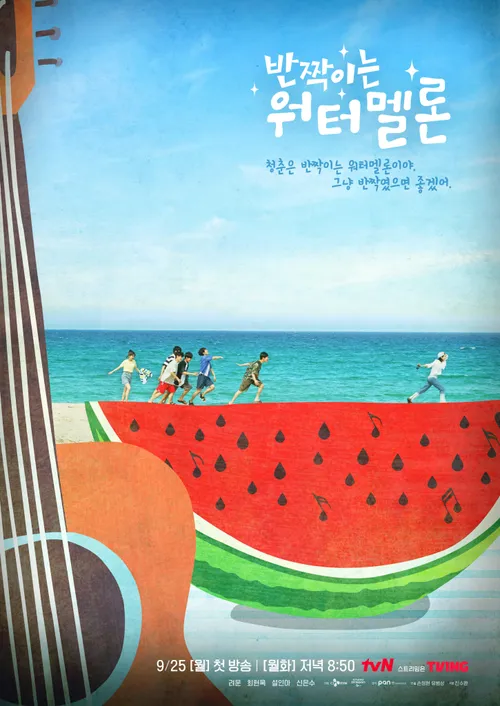
Pluck a guitar string and your fingertips know it first. The tremor travels faster than sound — a vibration that spreads from the resonant body of the wood all the way into your chest. 반짝이는 워터멜론 (Twinkling Watermelon) is a drama that begins in exactly that vibration. The moment someone who hears with their ears and someone who feels with their body stand before the same music — this story is poised on that boundary.
반짝이는 워터멜론 (Twinkling Watermelon) | tvN | 2023 | 16 episodes | Fantasy, Music, Family, Youth
Available on Rakuten Viki and Viu (availability may vary by region)
In the autumn of 2023, this drama began quietly, with no advance buzz — and then, from the moment it aired, it traced an entirely unexpected arc. During its run, it reached No. 1 on Rakuten Viki across twelve countries and spread rapidly through word of mouth among international viewers. There was no star-studded cast, no source IP to lean on. What this drama had instead was a combination found nowhere else — the CODA experience, music, and time travel. The point where these three axes converge within a single narrative is the space that belongs to 반짝이는 워터멜론 alone.
Between Silence and Melody
은결 is a CODA — a Child of Deaf Adults, a hearing child born to Deaf parents. He grew up interpreting at school meetings, relaying the doctor's words with his hands at the hospital, standing as a bridge between the world and his family. And he carries one secret: he loves music. When he holds a guitar, he feels his whole body come alive — but the knowledge that he cannot share that sound with his family is something that always catches somewhere inside him.
It is rare for a Korean drama to portray the daily life of a Deaf family with this kind of naturalism. What makes this drama stand apart is that it never consumes disability as a device for emotional effect. 은결's parents are not people in need of rescue — they are warm, funny human beings, and sign language is not a limitation to be overcome but the mother tongue of this family. The 2021 Academy Award–winning film CODA explored a similar emotional terrain, but the sixteen-episode format allows the tension and reconciliation between these two worlds to unfold across a far wider spectrum.
The scenes where sign language and music coexist on the same screen produce some of the most enduring moments in the drama. When 은결 plays guitar, the camera often strips away the sound and shows only his hands and his face. In that instant, the viewer is placed inside the perspective of his Deaf parents — things that cannot be heard but can be felt, things that are invisible but undeniably present. This drama operates on exactly that paradox.
1995 — Into a Father's Youth
Through the door of a mysterious music shop, 은결 arrives in 1995. There he meets his father at eighteen — the same age as himself. A father who plays guitar, who sings in a band, who can hear. A version of his father 은결 had never once been able to imagine.
Time travel in this drama serves a purpose beyond fantasy device. It is the experience of encountering a parent not as "Mom" or "Dad" but as a single, full human being. Through this device, writer 진수완 unpacks the weighty theme of intergenerational understanding without a word of sermonizing. The process by which a son witnesses his father's past firsthand becomes a passage through which viewers are invited to imagine their own parents' youth — the fact that they, too, were once eighteen, dreaming and stumbling and trembling with love.
The 1995 that directors 손종현 and 유범상 have restored is less visual than tactile. The resistance under your fingertips when you rewind a cassette tape. The weight of a pager in your school uniform pocket. The cool touch of the glass door of the neighborhood stationery shop as you push it open. Over the grammar of nineties nostalgia that Reply series and Twenty-Five Twenty-One laid down, this drama adds its own distinct stratum — the absence of sound. Even in that era, for this family, silence and music existed side by side.
Five Faces, One Youth
려운 shows a different texture of youth performance in this work. Having revealed his emotional range in 18 Again and absorbed darker tones in Through the Darkness, here he takes the stage holding a guitar. The interiority of 은결 — a boy who loves music yet fears that love may never reach his family — 려운 communicates not through dialogue but through the tremor in his gaze. In the expression on 은결's face as he sits in the audience watching his father sing on stage in 1995, admiration and understanding and sorrow pass through all at once.
최현욱 left his mark as a Viking-haired high schooler in Twenty-Five Twenty-One, then delivered a fierce presence in Weak Hero Class 1. The same nineties setting, but a completely different person — the linchpin of the band, brimming with mischief yet serious when faced with a dream. He is an actor whose background as a baseball player translates naturally into physical energy on stage. His father-son chemistry with 려운 is one of the drama's most convincing relationships — the dynamic two actors of the same age create together, something that is rivalry and protection simultaneously, friendship and paternity at once, sustains its fascination across all sixteen episodes.
신은수's performance in this drama is the work of setting down the most, and reaching the deepest. Having debuted in Curtain Call and drawn attention early, he now relinquishes dialogue as a tool entirely. As the Deaf character 윤청아, 신은수 conveys solitude, love, and joy through gesture, expression, and the angle of his body alone. What this actor's performance proves in every single scene is that having no words does not mean having no expression.
설인아 takes on the role that bridges two timelines — present and past — and stands on the technical challenge of a dual performance. Within the complex setup of a mother and daughter living in different eras, she simultaneously supplies the momentum for both the mystery and the romance. And 고두심 — appearing as the proprietress of the Snail Boarding House, she deepens the story of these young people with an unpolished warmth and a tenderness that needs no words. When the drama races forward at speed, the boarding house scenes hold the breath steady.
Viva La Vida — A Drama Where Music Is the Story
The band "Watermelon Sugar," which 은결 and 이찬 form in 1995, is not merely a narrative setup — it is the narrative itself. The process of the band growing on a live stage maps precisely onto 은결's journey toward finding his own identity.
If this drama's emotional core could be expressed in a single track, it would be the cover of Coldplay's "Viva La Vida." A song inspired by a Frida Kahlo painting — the moment the original song's arc of "I used to rule the world, but now I don't" overlaps with the story of a father who lost his hearing, the song is no longer a cover but one person's soliloquy. "Life is a twinkling watermelon" — the recurring phrase of the drama comes through most vividly via this song.
정주닐 (JOONIL JUNG)'s "A Song For You" is the track that most directly captures the emotion of a meeting that crosses time.
우리는 다른 시간 속을
We were wandering through different times
헤매이다 만났지
And then we met
수많은 사람들 중에서
Among so many people
그대를 알아보았지
I recognized you
A Song For You — JOONIL JUNG | Spotify
In the scene where Coldplay's "Yellow" cover plays, another register of emotion opens. 은결 playing guitar under yellow light; his parents, unable to hear the sound, watching the radiance on their son's face — in this scene, music is conveyed not as sound but as light. "HIGHER," performed by iKON's JU-NE (준회), pours the racing energy of youth into the song.
Tonight 난 두렵지않아
Tonight I'm not afraid
어떤 어려움도 우릴 가로막을 순 없어 Anymore
No hardship can stand in our way Anymore
HIGHER — JU-NE | Spotify
What Shines Does Not Disappear
If you are a fan of Twenty-Five Twenty-One, you will remember the lingering ache of that beautiful, bittersweet ending. 반짝이는 워터멜론 shares the same nineties backdrop and yet chooses a different road. This drama does not hurt. It is warm. When it makes you cry, those are not tears of sorrow. Within the genre of "healing time travel" that Lovely Runner and 18 Again have shown us, the reason this work holds its own distinct texture is clear — the CODA theme adds depth to the time travel, and music layers emotion on top of that depth.
When this drama ends, you may find yourself suddenly wanting to call your parents. Or perhaps you will take out an old guitar and pluck a string, just once. What 반짝이는 워터멜론 leaves behind is not a grand lesson. It is simply this one question — how much do I really know of the youth of the people I love? Whether through sound or silence, love finds its way across in the end. Through the trembling at a fingertip, through the warmth in a gaze, through something that shines.

