Surely Tomorrow
A Love Called Waiting — Waiting for Gyeongdo
In Samuel Beckett's Waiting for Godot, two men wait for someone who never arrives. Their vigil is absurd, meaningless, and — paradoxically — beautiful. The JTBC Saturday-Sunday drama Waiting for Gyeongdo translates that classic proposition into the language of love. Here, though, "Gyeongdo" is not a figure who refuses to come. He is someone who couldn't come, who wasn't yet ready — but who ultimately returns.
Lee Gyeongdo and Seo Jiwoo. These two met twice in their twenties and broke up both times — first as starry-eyed college sweethearts, then again at twenty-eight, when reality crushed their second attempt. Now thirty-eight, Gyeongdo has become an entertainment reporter. While investigating a celebrity affair scandal, he comes face to face with Jiwoo — as the wife of the man at the center of it all. Screenwriter Yoo Yeong-ah has crafted a setup that plants the "fated reunion" of romance dramas squarely in the most uncomfortable corner of real life. That is why the love in this drama aches before it flutters, and stings before it aches.
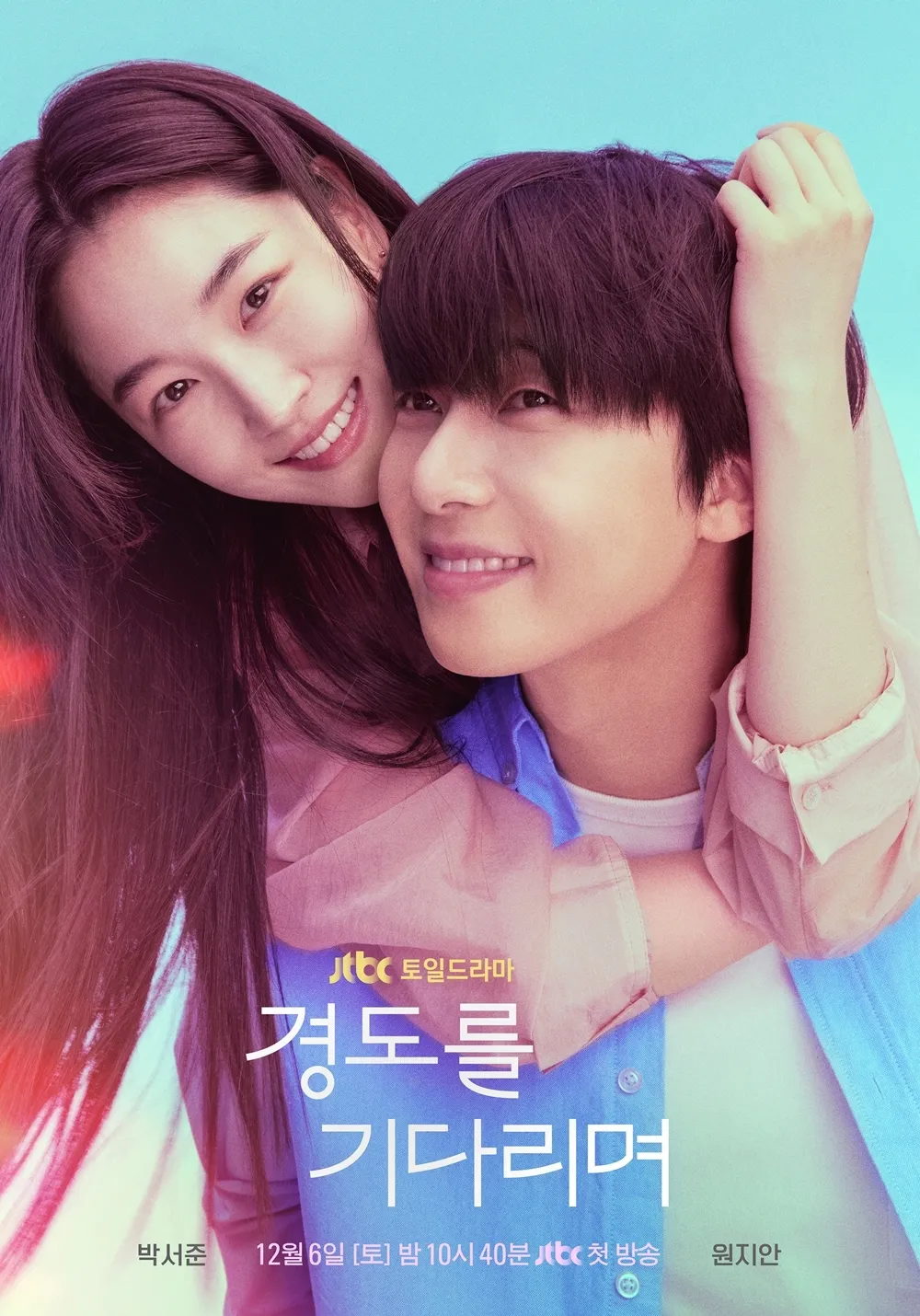
The twelve-episode series aired from December 2025 through January 2026. Ratings started at 2.7% and climbed to 4.7% for the finale — modest numbers on paper, but the emotional resonance among those who watched was impossible to quantify. Simultaneously released in over 240 countries through Amazon Prime Video, the distinctly Korean sensibility of the "reunion romance" genre traveled far beyond the barrier of language.
Three Seasons, Three Loves
The thread running through this drama is time itself. Early twenties, late twenties, late thirties — the same two people carrying the same feelings, yet time completely transforms the color of those feelings. Their first love was reckless because they knew nothing, their second was fearful because they knew too much, and their third is the love of maturity — the kind that only comes after losing something and finally understanding what truly matters.
Viewers were captivated by the structure that weaves between three timelines, though some also voiced fatigue over the frequent flashbacks. In particular, more than a few critics pointed out that the breakup scene in Episode 11 structurally mirrors the earlier ones. Yet that very repetition is central to the drama's thesis. Gyeongdo and Jiwoo are people who keep hitting the same wall: the failure to communicate, feelings left unspoken, timing that never quite aligns. The fact that they break up for the same reasons every time reveals that the problem with their love was never the other person — it was themselves. And it took ten years to accept that.
Within the tradition of Korean reunion romances, this drama has often been compared to Our Beloved Summer and Our Blues. The parallels are clear: the emotional weight that only time can build, those moments where awkwardness and familiarity coexist between two people meeting again. But what sets Waiting for Gyeongdo apart is how it places the uniquely Korean concept of "inyeon" (destined connection) into the most grounded context imaginable — an entertainment reporter and the wife of the man he's covering. Fate doesn't always arrive in a beautiful form, and that is what this drama reveals as the true face of destiny.
Malaga's Light, Seoul's Shadows
If you had to name the single most talked-about scene in this drama, there is no contest: the Malaga reunion. Beneath the dazzling sun of the southern Spanish coastal city, two people come face to face after ten years apart. There is almost no dialogue. Park Seo-jun's gaze trembles; Won Ji-an's lips quiver almost imperceptibly. The camera refuses to rush through that silence. The sequence, crafted by co-directors Lim Hyeon-wook and Choi Seon-min, spread rapidly across social media, and "the Malaga scene" became synonymous with the drama itself.
Malaga's visual splendor forms a deliberate contrast with Seoul. In the capital, Gyeongdo and Jiwoo are acutely aware of each other under the fluorescent lights of a newsroom, through the glass walls of a cafe, amid the noise of the city. If Malaga is the space where emotions erupt, Seoul is where they are suppressed. This contrast creates the drama's rhythm, and despite complaints about its slow pacing, it is the reason viewers couldn't let go until the very end.
International audiences responded particularly strongly to this visual storytelling. The series earned ratings in the 7-to-8 range on MyDramaList, generating word-of-mouth among fans who appreciate slow-burn romance. Overseas reviewers who read the drama through the lens of "the aesthetics of waiting" also drew thematic connections to Waiting for Godot. That said, some corners of Reddit criticized the relationship as feeling "obsessive" — an intriguing reaction rooted in the cultural gap around the Korean narrative tradition of "inyeon."
The Reporter and the Married Woman — The Media Faces Its Own Mirror
The choice to make Lee Gyeongdo an entertainment reporter lends the drama an unexpected layer of depth. The aggressive, invasive nature of Korean entertainment journalism is already well-documented through numerous public controversies. Here is a man whose job is to dig into other people's private lives — and his first love turns out to be the very person caught in the story he's chasing. The more articles Gyeongdo writes, the closer he gets to Jiwoo; the closer he gets, the less he can bring himself to write.
What keeps this premise from being a mere plot device is the drama's refusal to shy away from the tension between Gyeongdo's professional ethics and his personal feelings. He cannot be a good reporter and a good lover at the same time. The choices he makes in the face of that impossibility elevate the story beyond simple romance into a quiet meditation on Korean media culture. While flashback scenes featuring 2000s-era MP3 players and campus life tug at millennial nostalgia, the present-day Seoul sequences deliver a sobering reminder that nostalgia can no longer serve as an escape.
Park Seo-jun's Return, Won Ji-an's Breakthrough
For Park Seo-jun, Waiting for Gyeongdo marks his first romance role in seven years. Since What's Wrong with Secretary Kim, he has taken on the fiery young entrepreneur of Itaewon Class, the stoic survivor of Concrete Utopia, and even ventured into the Marvel Universe. He deliberately distanced himself from romance, and that very distance lends a unique texture to the character of Lee Gyeongdo. Where the earlier Park Seo-jun overwhelmed his counterparts with charisma and energy, here he plays the man who waits, who swallows his words, who channels an entire ocean of feeling into a single look — an old soul through and through.
Won Ji-an's presence entered a new chapter through this drama. Having made powerful impressions in D.P. and Squid Game 2, this was her first time anchoring a romance. The directors reportedly cast her for her "boyish charm" and "natural beauty" — an anecdote that explains why Seo Jiwoo breaks the mold of the typical K-drama romantic lead. Jiwoo is not glamorous. But in the moments when the depth of emotion hidden beneath her quiet composure surfaces, Won Ji-an's performance fills every inch of the screen.
The eleven-year age gap between the two actors raised concerns before the premiere, but the moment the first episode aired, those worries evaporated. What viewers distilled into the phrase "visual chemistry" was the kind of reaction that happens when two actors are matched not by age but by emotional wavelength. The tension created by their exchanged glances during the heaviest emotional scenes became the force that allowed this drama to quietly but unmistakably seep into the hearts of its audience.
Sung Si-kyung Sings the Song of Waiting
If you could distill this drama's emotions into a single piece of music, it would be OST Part 1, "On Some Day, With Some Heart." Composed, produced, and performed by Sung Si-kyung himself, the song's signature warmth tinged with sorrow meshes perfectly with the drama's emotional register. The moment this track plays, you can feel the exact temperature of Gyeongdo's heart across those ten years of waiting.
어떤 날 어떤 마음으로 — 성시경
마지막 봄 — 이승협
사랑은 제시간에 도착하지 않아 — 김다니엘
The single line "I used to hold on by taking out memories of you" encapsulates Gyeongdo's entire decade. Sung Si-kyung's voice renders that waiting not as resentment but as another form of love. Where Kim Daniel (wave to earth) unpacks the anguish and loneliness of love's missed timing through bilingual Korean-English lyrics in "Love Doesn't Arrive on Time," Kwon Jin-ah's "My Universe" completes the drama's emotional arc with the confession "You are my entire universe, my whole world." All three songs sing of different faces of waiting.
Tomorrow Will Come
Love doesn't arrive on time. This sentence — both the title of the drama's OST and its central thesis — is not a statement of despair but one of faith. It comes, even if it's late. You can meet again, even if it takes ten years. Waiting for Gyeongdo is a drama that proved, in an era of rapidly consumed content, that a slowly unfolding love story still has the power to move us. On JTBC or Amazon Prime Video, at your own pace, we invite you to discover this story of waiting.
Waiting for Gyeongdo (Surely Tomorrow) | JTBC Sat-Sun Drama | 2025.12.06–2026.01.11 | 12 episodes | Director: Lim Hyeon-wook, Choi Seon-min | Written by: Yoo Yeong-ah | Production: SLL, Studios I&N, Gulmoe | Global Streaming: Amazon Prime Video

